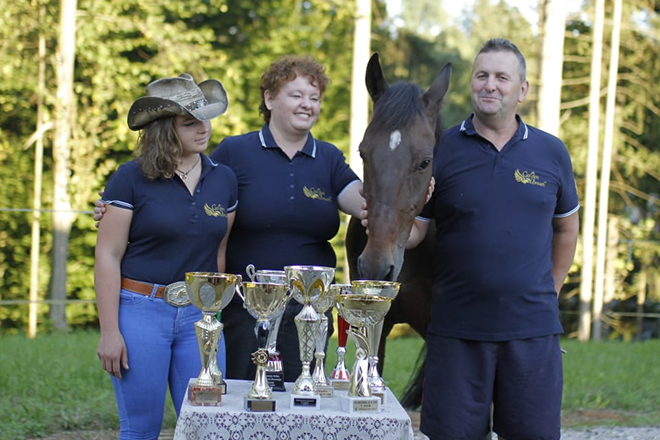
Horses are those beautiful creatures we adore. There has always been a deep feeling of friendship and trust between humans and horses. We just know that we love them but sometimes it is difficult to describe why. When we are around them, they make us feel so safe and relaxed. We understand the feelings of each other, which strengthens our relationship even more. They are so good-natured creatures. One of the things I appreciate the most in horses is their good heart. Horses would never betray us and they would always follow us wherever we go.
Horses bring people together. In the world where almost everything tends to be digitalized, horse races are still very popular and people still enjoy attending these social events. I was always amazed by their elegance, abilities to run, jump and do all sorts of other activities. Looking so powerful and brave when they are in the fields, they symbolize the freedom and that is exactly how we feel when we ride them – free.
Because of all of these reasons, it hurts very much when they fall ill. I was particularly interested in respiratory diseases in horses and wanted to find out if the horses can have a normal life even if they are susceptible to breathing problems. I felt that it was my duty and responsibility to help our companions so that they can be full of energy and life again.
COPD is a broad term for breathing issues in horses. There are several reasons for COPD to occur, the most common being chronic bronchitis. Chronic Bronchitis is an inflammation of the bronchial tubes. Other possible causes are pneumonia, air pollution, and untreated viruses.
After many years of observation and testing I came up with a treatment for horses with COPD and it is called GOLDEN BREATH.
This is a common airway obstruction disease horses deal with. It can be easily seen while they are at rest in stables. Clear signs of it include flared nostrils, persistent chronic cough, forced abdominal breathing and exercise intolerance. The disease occurs if the horse’s lungs are very sensitive to different types of irritants, such as: dust, moldy environment, ammonia, fungal particles etc. As horses’ airways are obstructed, the air needs to be forced through their abdominal muscles. They need to put a lot of effort in order to breathe. Horses’ breathing rate is normally 16 breaths maximum per minute but when they have some respiratory disease, it could be up to 4 times more. The condition must be treated, otherwise, it can become even more severe for horses’ quality of life.
These two conditions are very common. They can be caused by viral infections or by airway obstruction disease. When it comes to the clinical signs, they can vary from mild to severe cough. An owner can observe a mild cough at exercise, but if it becomes more serious it can lead to exercise intolerance. Wheezing is a particular harsh sound that a horse produces when it starts breathing heavily and it is a clear sign that the treatment must be carried out.
The crucial moment took place in 2013, with a newly purchased mare. She had some serious health issues, characterized by a heavy cough, a lack of energy and a very difficult breathing. The mare had previously been fighting with bacterial pneumonia, which resulted in very high mucus production. The treatment I decided to use with her was colloidal silver and after only two weeks, she was able to eliminate the yellow and green phlegm coughing it out. And after only a month, she was full of energy again and in the condition to continue racing with other horses. This success gave me a huge satisfaction.
Horses need to eat quality food because it is of utmost importance for their health. Nevertheless, it is not always possible to find quality hay. When summers are wet and
damp, which happened in 2012, hay becomes dusty and filled with fungi, which eventually leads to respiratory problems in horses. Some of my equestrian friends complained about coughing in horses, whose common characteristic was white slime discharge form their noses, heavy breathing and severe cough.
I offered to treat them using colloidal silver and even though some progress was made, it was just not enough to cure them. So, that was a turning point when I became eager to find a right solution. Having read a plethora of books and articles, I only came across with information about classical treatment of horses, using cortisone and bronchodilators. In this particular case, cortisone suppresses the inflammation in the lungs, but with many side effects. It affects the liver, the adrenal glands, it causes the reduction of the immune system, bone fractures, weakening of the tendons, laminitis and many other problems. Bronchodilators enable that air passes easier to the lungs by widening the bronchi.
But all that literature could not answer to my question: “Why and where does the mucus come from?”. Then, I decided to ask different professionals in order to see their opinion about the problem. I thought they would help me to find out the right answer. So I spoke with veterinarians, pharmacists, pulmonologists, herbalists, researchers of essential oils, I even consulted lots of websites, manuals but all sorts of advice and guidelines I was given did not turn out very productive for this medical condition.


As the time passed by, I was constantly thinking about the possible solution. But then, one day, I was watching one science TV show and it occurred to me – could the fungi be the answer to the lung inflammation with or without a white discharge from the lungs?
Following my instinct, I decided to conduct a research in that direction. The vivid example of it was Dior, the trot horse owned by Novak Igor. This horse was under veterinarian care for two years using classical treatment. Nevertheless, his health state was going from bad to worse and when he came to me, he was in a very poor condition.
I suggested to try the Golden Breath therapy as the final treatment. After only one month he started exercising. He was given natural medicine for two months. And four months since the beginning of the therapy, he won the race in a very tight competition in Krško with an excellent score of 1.13.9. His success evoked my desire to continue investigating about pulmonary diseases. So, I wondered, are bronchi irreperably damaged when the horse has a chronic bronchitis?
Eager to see how the horses would respond to certain kinds of treatments, I did a research. Among the treatments I used, there were spice extracts, colloids, tinctures of herbs, herbs, bioenergy and movements. In only four months, I accepted eight horses. They were in a very bad health condition. Most of them were already treated but the veterinarians gave up on them. The veterinarian Mr. Kovač Janez performed an examination of their medical condition. First of all, I fed horses with haylage and let them graze in the field. Haylage is a hay dried down to the humidity of approximately 80% and wrapped in foil. It is bailed and the fungi, which are very harmful for their respiratory system, can’t be produced.
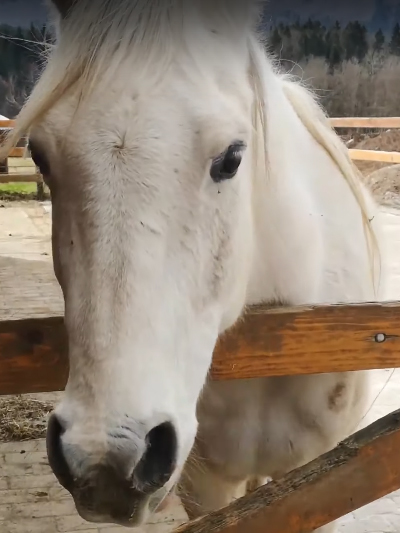

I observed reactions to different combinations of the therapy. I also began with the colloidal therapy but the initial improvement was little. Then I continued the treatment using herbs and essential oils but not all the horses responded successfully to all the herbs.
My daughter Urška also helped me in this process. Every day, she would test their energy improvement, mucus elimination and the power of breathing. We both kept following their health condition. Thanks to the proper exercise and a lot of movements, the mucus was discharged, which facilitated the horse to get the air into his lungs. But my intention was always clear – I wanted to improve the immune system itself.
At the end of the therapy, I tried to feed all of them with wet hay in small quantities. What I did was to wash that hay to see if it could work that way. But I was very surprised by the outcome since it turned out that the cough and mucus appeared again in all the horses for a short period of time. That was the clear proof to me that the fungi are not only outside the grass plants but inside them also. If a hay contains fungi, the horse’s body will let us know because it will react through its gastrointestinal tract and the breathing difficulty will recur. When they are at home, it is important to work on their immune system improvement so that the body does not get irritated with fungi. Therefore, the horses graze in the field or eat haylage from six months to one year depending on the severity of the health condition. Only after that, the owners can start feeding them with healthy hay without dust. The outcome of the research was such that all test horses felt much better than when they came to me. As for the breathing improvement, upon arrival they had up to 48 breaths and on departure they were under 16 breaths.
UWhen they were about to go home, I gave useful pieces of advice to the owners. I told them that it would be the best for the horses to be outside in the fresh air, avoiding dust and mold because walking in nature accelerates the cleaning of the respiratory tract.
It is not recommended for them to be in stables, they should spend most of the time walking because that will help them to eliminate the mucus gradually, especially walking up the hill. That way the lungs start working and help the mucus to come out. Of course, the horses have to be burdened and the owners have to train with them but they should not be overwhelmed with movements. The mucus elimination takes time, approximately one month.
I also advised them not to feed their horses with wet hay. For some reasons, there were owners who did not follow my recommendations and they fed their horses with wet or dry hay and some of them even did not train with them. Unfortunately, the result was that the cough and mucus appeared again.
For me, that was a valuable piece of information when the problems came back. But those who did follow my instructions have had healthy horses to this day. For example, Dior from Igor Novak participates in horse races and two years after the Golden Breath therapy, he was the winner six times, five times he came second and twice he came third at the Championship of Slovenia. Then, Dušan Babič and his Joy walk long terrains in the hills, Tinkara Broden and Geta travel around Zasave´s region, Peter Požar and Šah race around Kočevje meadows, Patricia Klemenčič and Golda race along Mura and there are many others. During this period there was no need to repeat the therapy.
In 2018, we started working with the veterinarian Tilen Klevisar. He presented to me the benefits of gold in the treatment of animals. So, I decided to try a gold-based therapy and the results impressed me.
The energy and life functions were increased and the whole recovery process was faster. After having seen the benefits of this therapy, I wanted to incorporate it in my basic treatment. It has been six years from the trials and four and a half years form the first Golden breath therapy. And the results speak for themselves.
Some of the steps in the Golden breath therapy:•When we receive an animal, first of all, the health state is being assessed with a special attention to the heart.
•After that, we start with the gold-based treatment.
•Then, we apply the pre-therapy in order to alleviate the inflammation and liquefy the mucus. We also put the animal either on pasture or in a horse stable, depending on the circumstances.
•An animal is being observed, treated with spices, herbs, essential oils, colloids and bioenergy and it is being exercised on a daily basis. At this point, the aim is to remove the fungi so that the mucus can start flowing out of the horse and the immune system can go up. After a short time, the horse starts to breathe easily. The whole therapy lasts from 4 to 5 weeks but after only 10 days, the horse starts to saddle. It takes approximately two months to eliminate the mucus.
•Then, after the horse arrives home, it is crucial for him to spend a lot of time on the fresh air. That will strengthen his immune system and the capacity of his lungs. The food component is also very important for their recovery, so haylage is fully recommended for at least a year and after that non-dusty hay must be the priority for the owners.
There was one case that particularly attracted my attention – one stallion. The first veterinary diagnosis confirmed that he suffered from bullous emphysema as a consequence of untreated pneumonia. When I received it, he was a wheezy horse with a very bad condition, he almost could not walk. After using Golden breath therapy, improvement could be observed after only four weeks. After gaining muscle mass, he was able to do up to 10 km, walk with galloping and light trotting but since he still had this buzzing sound in his lungs, his speed and stamina could not be developed in a proper way.
I am often asked about the way to bring the bronchi back to the original state. I have to say that it is something I cannot do, but what I can is to alleviate their respiratory system so that they can have a normal life. By getting rid of the fungi, eliminating the mucus and restoring the immune system, horses will be able to get more oxygen into the body and their energy will come back. After that, they can lead a healthy life and return to their usual activities.
Consulted references: 1. C. van Maanen & A. Cullinane (2002) Equine influenza virus infections: An update, Veterinary Quarterly, 24:2, 79-94, DOI: 10.1080/01652176.2002.9695127 (April 10 2020). 2. Horse & Hound: Coping with breathing problems (April 10 2020). 3. Kentucky Equine Research: Heaves and other breath problems in horses (April 10 2020). 4. Vet Services; Hawke’s Bay: Coughing and wheezy horses (April 10 2020).
I'm dealing with horses from childhood. I was attracted by their elegance and power.
I have my own horses for 26 years. I was always interested in alternative medicine and the possibility of helping her with animals.
After a personal traumatic experience, the alternative was completely rediscovered. I was also interested in exploring horses with a breathing problem.
If your horse has asthma, bronchitis or some other type of respiratory disease, Golden breath is the right choice for healing.
contact us